
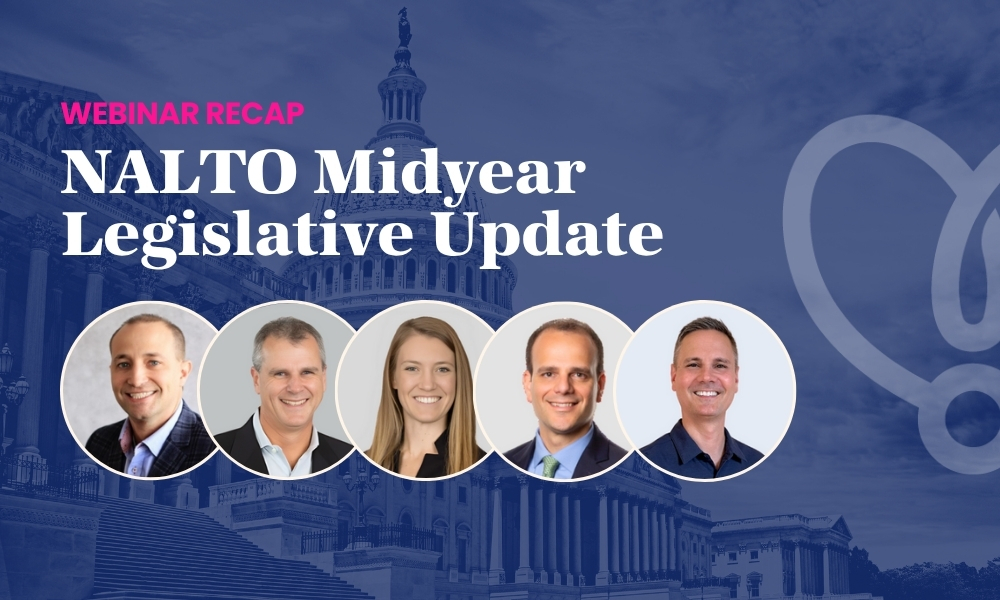
 On July 8, 2025, NALTO hosted a timely legislative update webinar moderated by Locumpedia founder Cory Kleinschmidt.
The session provided critical insights into recent federal and state-level developments affecting the locum tenens industry.
NALTO President Jarin Dana (Fusion Healthcare Staffing), Legislative Committee Member Anthony Szydlowski (Health Carousel), and NALTO’s federal lobbying partners, Ryan Bernstein and Mimi Bair from McGuireWoods Consulting, shared strategic updates, legislative progress, and grassroots advocacy priorities.
NALTO members can watch a recording of the 55-minute webinar by visiting the NALTO member site. Below is a recap provided by Locumpedia.
What’s Next for H.R. 1160 and Why It Matters
The webinar kicked off with a deep dive into H.R. 1160, a bill introduced in Congress in 2024 to formally distinguish locum tenens physicians and APPs from gig economy workers under federal labor classifications. Without this clarification, locum tenens physicians could be lumped in with gig workers, such as Uber drivers, despite working under vastly different conditions. In the worst-case scenario, this could result in massive staffing shortages and significant gaps in patient care.
Fortunately, momentum for the legislation is building. The bill continues to gain traction in Congress, having attracted additional co-sponsors, including influential members of the House Ways and Means Committee. While H.R. 1160 was not included in this year’s federal budget reconciliation package (largely due to the package’s focus on tax and Medicaid priorities), NALTO’s advocacy laid critical groundwork for the future.
 In preparation for the next opportunity later this year, NALTO engaged Senate procedural expert Marty Gold to assess how the bill can meet the requirements of the Byrd Rule, which governs what may be included in reconciliation legislation. A second reconciliation bill is anticipated in fiscal year 2026, and the legislative team is already exploring strategic paths forward, including bipartisan opportunities through tax extender or healthcare policy packages.
As Mimi Bair of McGuireWoods explained, “We’ve explained that this bill doesn’t impact gig economy workers. These are distinct policy issues. Once that’s clear, the logic of supporting H.R. 1160 really lands.”
Building Bipartisan Momentum
 Despite strong Republican backing, one theme emerged clearly during the discussion: bipartisan support is crucial to unlocking multiple legislative pathways and strengthening the bill’s chances of success.
“We’ve only had Republican support so far,” noted NALTO Legislative Committee Member Anthony Szydlowski. “If [NALTO members] have relationships with Democratic legislators, now is the time to step up and help us broaden that base.”
Achieving cross-party alignment would allow H.R. 1160 to be considered in a broader range of vehicles, including bipartisan healthcare packages and tax legislation. As Ryan Bernstein of McGuireWoods emphasized, “If we can make this bipartisan, then we have several paths forward, either through tax extender legislation, healthcare policy packages, or reconciliation. That gives us real legislative flexibility.”
 To maintain momentum, NALTO encourages its members and industry stakeholders to sign and circulate the official letter of support for H.R. 1160 and to utilize NALTO’s grassroots action platform at nalto.org/action to contact their federal representatives.
Every outreach effort makes a difference. As Jarin Dana later reminded attendees, “The longer you’re around on an issue, the more you rise in priority. Every letter, every meeting, every outreach moves us forward.”
How NALTO Is Responding to Article 29-K in New York
After the webinar wrapped up discussion on federal legislation, their focus shifted to New York State, where the interpretation of Article 29-K is creating compliance and operational challenges for locum tenens staffing firms.
While it was initially intended to regulate nurse staffing in the wake of COVID-19, Article 29-K is now being interpreted by the New York Department of Health to include physicians and APPs as “direct care personnel.” This interpretation extends the law’s licensing and reporting requirements to locum tenens clinicians, which could increase patient care gaps.
In response, NALTO engaged New York lobbying firm Constantinople & Vallone to challenge this interpretation. While initial efforts focused on requesting clarification and correction from the Department of Health, followed by direct appeals to executive health leadership, this was just the beginning. Now, NALTO is shifting its focus to a legislative approach.
Legislative Progress and the Road Ahead
While the path hasn’t been easy, meaningful progress is underway. During the 2025 session, NALTO successfully secured legislative sponsors in both chambers of the New York legislature who introduced bills to exempt physicians from Article 29-K. Even though the bill didn’t make it out of committee, it marked a key milestone. NALTO now has active champions ready to carry the fight forward in 2026.
 In the months ahead, NALTO will focus on dialogue with potential opponents, including labor groups and the New York Department of Labor, to clarify the unique nature of locum tenens staffing. As Jarin Dana explained during the webinar, these conversations are critical: “We want to help policymakers understand that including locum tenens physicians in this law doesn’t serve the intended purpose and could ultimately reduce access to care.”
These regulations raise major concerns about data confidentiality, fair business practices, and misrepresentation of gross margins. NALTO continues to raise these issues with state officials, and in the meantime, is also advocating for a reduction in the reporting burden, including a shift from quarterly to annual reporting and improved data handling procedures.
“The statistics the state is publishing don’t reflect the true cost of doing business,” Dana noted. “They’re overinflating gross margins and sending the wrong message about the value of locum tenens care.”
NALTO remains committed to protecting the integrity of physician staffing in New York and will continue to build the relationships and momentum needed to secure a long-term legislative fix.