2024 Locum Tenens Rewind: Locums Continues to Dominate, AI Rockets to #1 in Top Topics, Physician Mental Health Evolves & So Much More
By Bradley Roberts
As the year 2024 A.D. winds down, there’s a buzz in the air—the holiday countdown is on, and we’ll soon set our out-of-office messages and bid colleagues farewell with a cheerful “See you next year!”
Before signing off to savor well-deserved rest, it’s time to reflect on the year that was—a memorable one in which the locum tenens industry kept smashing records and shooting for the stars.
If there had been any remaining doubt, locum tenens has fully emerged as a powerhouse in the healthcare sector. Amid mounting challenges in healthcare staffing, it proved indispensable in the fight to combat physician burnout, ensure patient care in underserved communities, and deliver flexible staffing solutions when healthcare facilities needed it most. This was a year where locum tenens soared above, thriving while other healthcare staffing segments faltered.
From unprecedented revenue growth and a surge of new locum tenens agencies to the integration of AI in staffing and groundbreaking discussions on physician mental health, 2024 was a transformative year for the locum tenens industry.
Locumpedia has been there every step of the way, chronicling the stories and milestones that made 2024 a banner year for locums. Join us as we revisit the defining moments, figure out what it all means, and look ahead to what’s next.
Contents:
Locum Tenens Drives Healthcare Growth
If there is one constant we can all be proud of this year, it’s that locum tenens has been the healthcare industry’s superstar. Locum staffing experts continue to predict locums will stay bright even as other healthcare sectors fade.
Staffing Industry Analysts (SIA) announced early in the year that locum tenens was the only healthcare staffing segment to experience positive median revenue growth at 15% the year prior. Locums leaders concurred in our 2024 Locum Tenens Industry Outlook: among them, Joseph Brunson, founder and CEO of Tusk Enterprises; Ty Chambers, president of Rosman Locum Tenens; Natasha Lee, CEO of Floyd Lee Locums; and Matt Young, managing partner at All Star Healthcare Solutions. All expected 8–10% growth. Drew Cihlar, senior VP at Hayes Locums, forecasted an increase of more than 10%.
Later in the year, SIA underscored its earlier message with the September update of its US Staffing Industry Forecast, which reported that the healthcare staffing sector had declined in market size for the first time since 2010, except for locums tenens, which once again outperformed other segments and was expected to continue to grow up to 12%, making it the fastest-growing area of healthcare staffing.
Key Trends Driving This Growth: Healthcare Organizations and Providers
In a 2023 CHG Healthcare study, a vast majority of healthcare facilities (82%) said they most often work with locums while they actively recruit for permanent positions. Nearly half of healthcare organizations surveyed (46%) said they do so to prevent revenue loss while they search. This includes working with locum APPs to address the nationwide physician shortage, particularly in places that struggle to retain physicians, such as rural areas.
A separate countrywide survey by CHG indicated that locums tenens is attracting physicians across the board who are looking to spice up their careers. Of those physicians who recently adjusted their career goals, 44% reported turning to locum tenens as part or all of that change, a noticeable increase from 28% in the previous survey. Most of those who added side gigs preferred locums opportunities (60%) over moonlighting (40%). Another survey found that millennials, Gen X, and baby boomer physicians are trying out locum tenens: Around 28% of millennials reported doing locum work for at least one-quarter of their jobs, compared to 26% of Gen X and 24% of baby boomers.
The Q4 2024 State of the Market healthcare report from Medicus Healthcare Solutions highlighted specialties growing in demand and the locations projected to see the most significant physician deficits—indicators of where locum tenens providers will be needed most. They highlighted several hot specialties, including cardiology, which is expected to grow by 17% over the next 12 years, and critical care, pulmonary, and urology, each projected to increase by 14%. By 2028, the states most in need of physicians are anticipated to include Texas, New York, and Missouri.
The 31st annual Review of Physician and Advanced Practitioner Recruiting Incentives reported that average starting salaries for physicians in all specialties and APPs (NPs, PAs, CRNAs) are up yearly and often include impressive signing bonuses, relocation packages, and continuing education allowances.
Doximity reported similar data in its 2024 Physician Compensation Report, which revealed an increase in overall compensation among more than 33,000 full-time US physicians in 2023, up by 6%, a positive movement over the 2% increase from 2022. The gender pay gap dipped slightly to 23%, down from 26% in 2022 and 28% in 2021. Certain states and metro areas offer higher-than-average physician salaries due to cost of living, geographical remoteness, and demand for quality care. Since locum opportunities often command higher salaries than permanent positions, these general figures are encouraging for providers.
Separately, experts at Medicus and the Association of American Medical Colleges noted the predicted shortfall of nearly 50,000 primary care physicians by 2034. With most NPs choosing to work in a specialty field, where they can earn significantly more without the cost of additional endorsements, The Physicians Foundation found that there will also be a need to bridge the gap in primary care NPs.
Still, 75% of physicians surveyed said they’d be willing to accept, or have already received, less pay for more autonomy or work-life balance. That perspective on compensation supports the projected growth of locums as more physicians choose another benefit that locum tenens offers: flexibility.
Agencies and Health Systems Test out AI Tools

AI made significant waves in healthcare this year, boosting diagnostic precision, streamlining administrative tasks like scheduling, improving data collection, research hypotheses, teaching, and elevating patient care.
Agencies can combine AI-generated analytics with their human expertise to enhance the recruiting process, supplying data-driven insights that pinpoint necessary candidate skills and help uncover “nontraditional candidates.”
CHG Healthcare wrote a guide to leveraging AI for recruitment, including the serious pitfalls an agency must be aware of; the key is to have defined reasons for using AI with an execution plan. The American College of Physicians also urged healthy skepticism around AI, offering considerations for medical practitioners, lawmakers, and patients who are thinking about AI use in healthcare: patient privacy must be prioritized; AI must be used to improve, not worsen, disparities in healthcare; and training in using AI must be part of a clinician’s education throughout their years of practice, not as a one-time aside. The focus must continue to be on developing HIPAA-compliant versions.
The past year was only the beginning of how AI can improve locum tenens staffing—the technology is evolving rapidly, and we’ve only scratched the surface. That’s why we felt it necessary to perform a deep dive into its capabilities. We’ll be kicking off 2024 with a special content series exploring how AI is shaping locum tenens staffing—what’s possible, what’s next, and what it means for providers, agencies, and facilities. Be on the lookout for this in the coming days!
Harnessing the Power of Language

If there’s one thing we love as much as locum tenens, it’s talking about locums tenens. But this necessitates a thoughtful consideration of our word choice. This fall, we published our guide “Locums Lingo for Physician Staffing.” After providing a quick but thorough history of the term, we set the stage for further discussion about the practical uses of the words “locum tenens,” “locums,” and “locum.” We did our best to break down the right way to use it and what to avoid, along with a quick-view infographic. (Our tip for that? Print it out, post it somewhere in the office, and embed it into your daily practice to keep communications with clients and candidates consistent!)
But this isn’t where our language exploration ends. Perhaps nowhere has language been more powerful this year for doctors and staffing firms alike than it was in the discussion around mental health questions in credentialing applications. Research has shown nearly half of physicians worry about the repercussions they may incur stemming from their answers to official questions about their mental health and treatment. There have been some significant improvements this year to help remove the stigma associated with mental health:
- The Federation of State Medical Boards, the Joint Commission, and many national organizations no longer require physicians to provide their mental health history.
- More than half of state medical boards’ licensing applications and many health systems no longer ask invasive medical history questions.
This year also brought a notable shift in how we refer to “PAs” and what the abbreviation represents. In June, Oregon became the first state to officially change the title of “physician assistant” to “physician associate.” This change aims to address misconceptions about the profession and better align with PAs’ medical education and responsibilities. As part of broader efforts to modernize the field, the American Academy of Physician Assistants fully supports the update, emphasizing that it does not alter PAs’ scope of practice or legal responsibilities. For now, PAs in other states must continue using the title “physician assistant” unless similar legislation is passed in their state.
The term “physician burnout” continues to draw headlines in healthcare, with growing recognition that systemic changes are needed to address—and hopefully one day eliminate—this issue for millions of providers nationwide. Yet, those providers still fear the term’s overuse risks diluting its significance and urgency. As combating burnout stays front and center in healthcare staffing discussions, we’ll be monitoring it closely to see what meaningful actions follow the rhetoric.
Increasing Agency Impact

Locum tenens is more popular than ever. Agencies can set themselves apart in various ways to attract and retain facilities and physicians and influence client decision-making. Agencies can make themselves, their physicians, and their APPs attractive to facility recruiters by focusing on three primary factors:
- Deliverability: Get detailed with your submission’s work history, including the number of assignments, where they were placed, and what sets them apart.
- Quality: Exemplify quality service by being proactive with facility requests and ensuring responsiveness. Be able to explain how you successfully handle changes and updates that will inevitably arise during assignments.
- Support: Share details pertinent to facilities recruiters’ concerns about administrative tasks. Effective locum partners can reduce the administrative burden by offering robust credentialing and licensing assistance.
Cost is important to facilities but can easily be negotiated if those three priorities are aligned. In many cases, you can also help shift the mindset from financial burden to gain by ensuring facilities know how to bill for the locums.
In its report “Best Practices to Grow a Healthcare Staffing Firm,” SIA recommended five growth areas that healthcare staffing firm owners and executives should consider:
- Specialize: This means starting to focus on locum tenens or niche specialties.
- Have a growth marketing mindset: Pay attention to the whole funnel, not just top-of-funnel activities.
- Be active on social media: Start judiciously tagging potential clients when sharing your market insights.
- Plan your tech stack to take advantage of new technology, such as ChatGPT, while streamlining the broader ecosystem of applications and solutions.
- To ensure data quality, measure a small number of key metrics and expand by one or two metrics at a time.
Agencies have an opportunity to set their facility clients up for success by exploring ways to incorporate locums into their clients’ current staffing models:
- Position locums as team members rather than as expendable commodities.
- Establish a thoughtful onboarding process for locums that connects them with other team members, shares the facility’s mission, values, and strategic priorities, and acquaints them with the facility.
- Be transparent with your metrics and how locum tenens providers will be measured.
Rural and other remote locations benefit from agency guidance on seeking and vetting locum tenens providers for these settings. Physicians and APPs who thrive in such environments typically possess the following:
- Adaptability to deliver care with limited resources
- Cultural competency to honor the diverse communities that call rural areas home
- Strong communication skills to collaborate effectively with administrators, colleagues, and patients
- Tech-savviness to quickly adapt to various systems
By sharing industry insights, agencies create value for their facility clients and reasons for connecting beyond job openings. Some of those include:
- The Innovation Imperative for Physician Retention
- Research from McKinsey and Staffing Industry Analysts
- Physician and Clinician Onboarding Research Report
Given the range of a provider’s knowledge and experience level they have, it can be helpful to point them to these six podcasts that offer insights into various aspects of locum tenens work:
- Locumstory Podcast
- The White Coat Investor
- ReachMD
- The Financial Residency
- Docs Outside the Box
- KevinMD
The Year’s Industry News of Note

So, those were a few of the biggest headlines that caught our attention over the past 12 months, but there’s plenty more where that came from—M&A activity, new hires, promotions, and accolades galore. Here are other notable developments from 2024:
In the remaining days of 2024, Aya Healthcare dropped a bombshell, announcing its $615 million acquisition of Cross Country Healthcare, signaling a significant milestone in the growth of two of the nation’s largest locum tenens agencies. The move will combine their complementary, tech-enabled staffing solutions and help diversify Aya’s reach across all 50 states in locum tenens, travel nursing, and clinical services in schools and homes. This move, unanimously approved by Cross Country’s board, will make Aya the fifth-largest locum tenens firm, with an estimated $350 million in annual locum tenens revenue.
In spring, Knox Lane, a San Francisco-based private equity firm, acquired a majority stake in All Star Healthcare Solutions. Ken Bernstein continued as All Star’s president, and the agency’s leadership hopes this partnership will also allow them to scale at an accelerated pace and expand their service options.
In other news that could directly impact provider contracts, a new ban on noncompetes, as ordered by the Federal Trade Commission, could significantly benefit physicians currently under such agreements and intensify hospital staffing challenges.
Earlier this year, Florida and New Jersey joined 40 other states, Washington, DC, and Guam, as members of the Interstate Medical Licensure Compact (IMLC). The IMLC is a tool that allows locums to acquire licenses easily in multiple states.
Both CHG Healthcare and Integrity Locums had some C-Level shake-ups:
- Leslie Snavely was promoted from president to CEO of CHG in August, succeeding Scott Beck, who retired after 25 years with the company. Since joining CHG in 2010, Snavely has held several key leadership positions, including president, chief sales officer, and chief strategy and digital officer. She was recognized on the list of Global Power 150 Women in Staffing and the Top 100 Leaders in North America in 2023.
- Jeff Files moved from president of Integrity to CEO as founders Tim Devereau and Lacey Salzer stepped into advisory roles. Files has worked in locum tenens staffing since 2005. Since joining Integrity in 2017, he has been known for fostering an inclusive and positive culture and building the company’s executive team.
Liz Hale, CEO of MPLT Healthcare, was named president-elect of the National Association of Locum Tenens Organizations (NALTO). The board has been instrumental in securing support for the Health Care Provider Shortage Minimization Act, which impacts locum tenens providers.
NALTO continued its trend of bringing the locums community closer—literally and figuratively. Here are a few examples:
- NALTO partnered with Advisory Board to improve membership benefits and give members actionable insights that address industry changes.
- In March, the NALTO/NAPR Annual Convention offered insights on the redefined physician landscape and new state laws, growing an agency, and what it’s like to be a locums provider.
- In September, locum staffing leaders gathered again for the two-day NALTO Fall Fly-In. They shared valuable insights and strategies to address physician expectations and hospital financial challenges, among others.
- While we’re on the topic of flying in, this year, we spoke to some locum legends who helped us put together a complete comprehensive history of how NALTO got its start in the hallowed halls of… an airport conference room.
- Additionally, the NALTO’s Code of Ethics, a direct result of those first-ever NALTO gatherings, has become the “glue” that holds the locums industry together.
- NALTO has updated its website to include new and expanded features, such as an events calendar, video library, member directory, and more.
Staffing Industry Analysts annually publishes several lists of interest to locum tenens insiders. Here are a few of them:
- Twenty-one locum tenens firms made the Top 100 Largest Healthcare Staffing Firms in the United States. According to the report, the locum tenens market was estimated to be worth $7.5 billion in 2023.
- The healthcare sector once again led the Fastest-Growing US Staffing Firms list, with 10 companies in the locum tenens space on the 2024 list, compared to eight in 2023.
- This year’s Global Power 150 Women in Staffing list included more than a dozen locums leaders recognized for using cutting-edge technology, developing more inclusive talent pipelines and vital DE&I initiatives, and supporting work environments that put individuals first, building employee engagement and well-being.
ClearlyRated’s Best of Staffing award-winning agencies were recognized for their outstanding service to healthcare providers and facilities. From our estimation, of the more than 120 physician staffing firms that primarily staff locum tenens providers, only 17 received this honor, or about 14% of eligible agencies.
Finally, CHG Healthcare’s travel nurse division, RNnetwork, announced it would close in March 2025. CHG is looking at taking the next year to refocus on locums, allied professional staffing, and healthcare technology and is significantly expanding its presence in North Carolina.
2nd-Annual Locum Tenens Providers of the Year

Every year, more than 50,000 physicians and APPs step into critical healthcare roles across the country, delivering lifesaving care to patients in need. These providers are often called upon on short notice, filling gaps for healthcare facilities that might otherwise be forced to turn patients away—or even close their doors if they can’t get someone to fill in. We feel that extraordinary commitment to patient care deserves some recognition.
That’s why, in 2023, for the second year in a row, we invited locum tenens staffing agencies to nominate locum tenens providers they believe went above and beyond in serving their patients and communities. The response was incredible: 32 nominations poured in from 11 agencies, highlighting the contributions of these locum professionals.
After a thorough review by our expert panel of judges, six winners were selected for the 2023 Locum Tenens Providers of the Year Award:
- Dr. Ziad Skaff, Medical Oncologist, represented by Floyd Lee Locums
- Dr. Edward Kondrot, Ophthalmologist, represented by Caliber Healthcare Solutions
- Dr. Kent Herbert, Family Medicine Physician specializing in Emergency Care, represented by Wapiti Medical Staffing
- Dr. Kia Jones, Otolaryngologist, represented by ENT Surgery Solutions
- Dr. Anish Oza, Anesthesiologist, represented by Medicus Healthcare Solutions
- Dr. Mahyar Afrooz, Hospitalist, represented by Interim Physicians
The winners were celebrated at the 2024 NALTO/NAPR conference in March, where the locum tenens community recognized their remarkable achievements. Each winner also received a $150 donation to the nonprofit organization of their choice.
We’ve already begun accepting nominations for our Third Annual Locum Tenens Providers of the Year Award. Submissions are open until February 3, 2025. We can’t wait to honor another group of outstanding locum tenens providers. Stay tuned!
Locumpedia Helps Honor Healthcare Heroes

This year, your friends at Locumpedia also played a small role in helping the industry celebrate its healers and their lifesaving talents:
- For the second year, we celebrated National Doctors Day with our free resource site, NationalDoctorsDay.org, which helps staffing firms and facilities celebrate doctors each year on March 30. The site features a marketing toolkit and a fresh crop of ideas on celebrating and supporting physicians. (Keep your eyes peeled for a new merch store coming in January 2025, to kick things up a notch.)
- Launched NationalHospitalWeek.org in April, ahead of the annual celebration on May 12–18, with comprehensive resources designed to support staffing firms working alongside their facility clients.
- In August, agencies celebrated National Locum Tenens Week in many ways, from spotlights on advocacy efforts to contests and giveaways. NALTO supported with a dedicated website and marketing toolkit that we helped them create, too.
Breaking Down Our News Coverage
It’s been a busy year for staffing agencies, healthcare organizations, locum tenens physicians, and APPs as locum tenens surged in the healthcare industry. Locumpedia is thrilled and honored to help you cut through the noise to hear the signal.
With our original reporting, biweekly summaries, and analyses of the biggest stories in locum tenens, we hope to help you think clearer, make quicker decisions, and lead stronger—whether it’s about your own career or the career of a whole team.
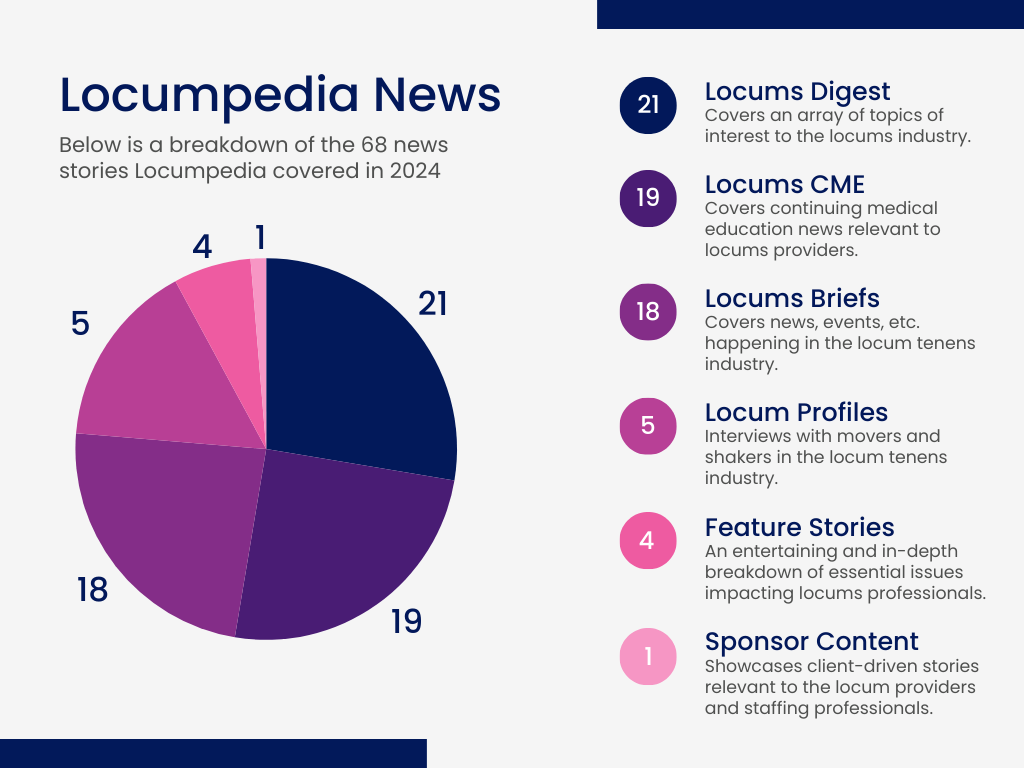
In 2024, we published 68 news stories, an average of nearly 6 stories per month across six departments: Feature Stories, Locums Digest, Locums CME, Locums Briefs, Locum Profiles and our newest addition of Sponsor Content.
Our Top 10 Most Popular Stories of 2024
Last year, our readers both focused wide to take in macro-level highlights and homed in tight to celebrate specific wins. We saw interest in the annual NALTO Conference, NationalDoctorsDay.org, and locum tenens growth forecasts. We also honored award winners and learned more about new locums-focused technology.
Our Top 10 stories comprised three Locums Digests, three Feature Stories, including one from our Locums Legends series, two Locums Briefs, and two Locum Profiles.
The Top 10 Topics in Locum Tenens
The more things change, the more they stay the same… Once again, issues such as staffing shortages and burnout piqued readers’ interest. This year, articles on locums careers and staffing, compensation, and recruitment—topics that look ahead to solutions—also resonated.
A topic that was new to the top 10 in 2023 shot to first place in 2024: artificial intelligence. And a topic that has been creeping up our year-end list, rural healthcare, shot from the seventh position last year to number three this year.
- Artificial intelligence is revolutionizing the entire healthcare industry, including locums.
- Locum tenens physicians and APPs help alleviate burnout among permanent staff—and working locums often helps those providers avoid burnout.
- Rural healthcare continues its popularity among our readers as rural facilities increase the use of locums in those settings.
- Staffing shortages continue to be a primary driver of locum tenens opportunities and more optimization across healthcare.
- NALTO is a perennial favorite because of its standing as the premier advocate for the locum tenens industry, its annual conferences, and now, its updated website, which makes it easier for firms to access its critical resources.
- Information about locum tenens careers resonated with readers as more physicians and APPs explored this full-time and part-time option.
- Understanding physician compensation helps providers and agencies alike know what’s possible for locums roles.
- Physician recruitment stories helped agencies support providers hoping to be successfully placed and position themselves to deliver what facility recruiters are looking for.
- Locums can “travel” to bridge gaps without leaving home via telemedicine opportunities.
- Physician wellness remained a central focus for providers this year, with particular attention on ways to safeguard their mental health and achieve better work-life balance